Appreciating the UW
Integrated Social Sciences Program
Participating in the Integrated Social Sciences program at the University of Washington was a valuable experience: five core courses, two method, two portfolio and one writing focused, helped me to grow as a writer. The core program earnestly delivered an interdisciplinary framework, a digital community of professors, peers and processes, supporting this eager participant with research structure and an ensemble of mentorship. Participants and professors provided weekly feedback through forum discussions and peer review, of essays, annotated bibliographies and other pieces of writing, an absolute luxury for research writers to test ideas and readability.
The Integrated Social Sciences (ISS) program introduces students to a wide range of discourses on social topics, from social justice through information technologies, we are challenged to create thesis interweaving themes from across disciplines. Our portfolio works as a tool to guide our thought, collect our work, and share that work with peers, and to review our work as a mnemonic device. As the work grows, it is after all a digital artifact, any portion of the portfolio may be revised, to further develop toward a cohesive thesis, a thematic collection and a capstone assignment toward the ISS degree.
As an [almost] ISS graduate, I’ve gained experience in qualities referred to as “T-Shaped”, multi-skilled and transdisciplinary, able to develop both a broad perspective and pursue focused inspection in the social sciences. As a professional in software development, these are not new skills: successful programming requires appropriate solutions, understanding the problem at hand through constant exploration and research (Wohlin, Šmite, Brede and Moe, 2015) . Coders are great at solving relatively tame problems, but it takes expanded experience in social sciences to engage the wicked problems of software development (Dooley, 2017; Ralph, Chiasson and Kelley, 2016); thus those T-Shaped people me, “combining problem solving (deep) and communication (broad) skills” (Donofrio, Spohrer, Zadeh & Demirkan, 2018, p.175), are in high demand.
When I began this program, I was well into my second year of development on my treatise of management theory, with the work title, “Humane Waste: Making sense of American busy work”. I’d read through nearly a hundred books, assembled copious notes, a few case studies and had first-hand experience of management from nearly two decades of experience in and out of American business as a software developer and entrepreneur. Where my consumption of Harvard Business School’s HBX curriculum enriched my understanding of corporate leadership, ISS engaged my analytic and research drives, encouraging me to passionately write and read ever-deeper into the pains of poor decision-making. With a couple years of exploration into project management practices, becoming a Professional Project Manager (through the Project Management Institute) and taking several certifying courses around adaptive management theories (termed “agile”, in the industry), I was uncertain how to turn my knowledge acquisition into a set of transformative essays, into knowledge transfer. This is, fundamentally, why I turned to the ISS faculty, and their program was absolutely fantastic in guiding me forward.
Since taking the course I’ve completed several strongly researched essays, bringing an academic rigor and integrity to my writing that would otherwise be missed. My writing itself has become more approachable as I’ve come to produce incisive, pithy paragraphs, saving longer prose for appropriate academic discourse. The book “They Say / I Say” by Graff & Birkenstein (2016) has become my favorite writing guide, wonderfully expressing the modes of discourse in academics, especially within the social sciences. These courses and these professors encouraged me to build out a portfolio, nudging me toward public feedback much sooner than I’d have otherwise taken the step. I’m now ready and positioned to complete and solicit feedback for the various chapters of my book, and to begin on my next adventure in academic research, as I apply to masters programs in Data Science. I’m eternally grateful to the UW staff that developed this program, I will miss their encouragement and the warmth in which they continually deliver through their dedication as bearers of the liberal arts.
References
Donofrio N.M., Spohrer, J., Zadeh, H.S., & Demirkan, H. (2018). Research-Driven Medical Education and Practice: A Case for T-Shaped Professionals. In Y. Moghaddam, H. Demirkan, J. Spohrer. (Eds.) T-Shaped professionals: Adaptive innovators. New York, NY: Business Expert Press.
Dooley, J.F. (2017). Software Design Problems: Wicked or Tame? In Software Development, Design and Coding: With Patterns, Debugging, Unit Testing, and Refactoring. New York, NY: Apress. Retrieved from https://www.apress.com/de/blog/all-blog-posts/software-design-problems-wicked-or-tame/15558942
Graff, G., Birkenstein, C. (2016). They say / I say: The moves that matter in academic writing 3E. New York, NY: WW Norton and Company.
Ralph, P., Chiasson, M., & Kelley, H. (2016). Social theory for software engineering research. In Proceedings of the 20th International Conference on Evaluation and Assessment in Software Engineering (EASE '16). Article 44. New York, NY: ACM. https://doi.org/10.1145/2915970.2915998
Wohlin, C., Šmite, D., & Brede, Moe, N.B., (2015). A general theory of software engineering. Journal of Systems and Software, 109(C), 229-242. https://doi.org/10.1016/j.jss.2015.08.009
Spotlight on a Scientist
Professor Sara Vannini, University of Washington
The Integrated Social Sciences faculty develops the interdisciplinary program
Sara Vannini, a self-described “Citizen of the World” has a PhD in Communication Sciences and research focuses of “Information and Communication Technologies for Development (ICT4D), Social Appropriation of Technology, e-Learning and Instructional Design” (Vannini, Personal Website). Her most cited publications often include keywords about “design” and “community” usually in the context of a visual media. Where the visual aspect of “multimedia” or “photography” is highly technical, the concept of “design” is polysemous, as is “community” and Google NGram Viewer shows the rise in usage of these two terms over the last century.
In my own work, I’ve found the term “design” to be difficult to speak about, as it requires some shared understanding that in order to design, we must first have some kind of shared intent. To develop a shared intent, we first need to identify as a community of action. In my current position, the company calls this community “One Team” (Expedia 2016, internal documents). It is difficult to define community, even within a single company, even within a single floor and single division. Frequently in software development we will use the terms “Community of Practice” or “Community of Excellence”, or “Center of Excellence”. That aside, we must go from community to design, if we are going to enact some shared vision. This design again requires alignment: a design must have some sort of hypothesis behind it. Vannini’s study on Community Multimedia Centers in Mozambique (Vannini & Rega 2012) gives an excellent example of finding community and defining an intent that communications centers be “recognized as a mean to participating in the knowledge society”, while demonstrating through surveying that the intent was not realized. By looking at the rise of the keywords “design” and “community” we can see a possible synchronization of their uses, starting in the 1990s, as “design” became more widely used in the context of a “knowledge society” promoted through Internet connectivity
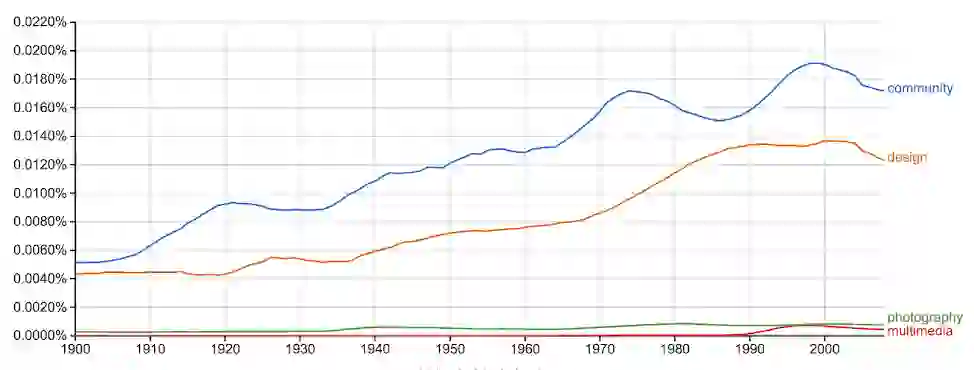
Google NGram Viewer of the terms “design” and “community”.
References
Vannini S and I. Rega (2012) “Information and Communication Flows through Community Multimedia Centers: Perspectives from Mozambican Communities.” Information Technology for Development, vol. 21, no. 1, 2013, pp. 85–98.
Vannini S. Personal Website. Accessed: http://www.saravannini.com/
Vannini S. Google Scholar Profiles. Accessed: https://scholar.google.com/citations?user=IrNFtBEAAAAJ&hl=en&oi=ao
Community, Design on Google NGram Viewer. Accessed: https://books.google.com/ngrams/graph?content=community%2Cmultimedia%2Cphotography%2Cdesign&year_start=1900&year_end=2008